


A community of experts that brings together top talents in academia, industry and the public sector to solve real-life problems using both existing and novel AI.
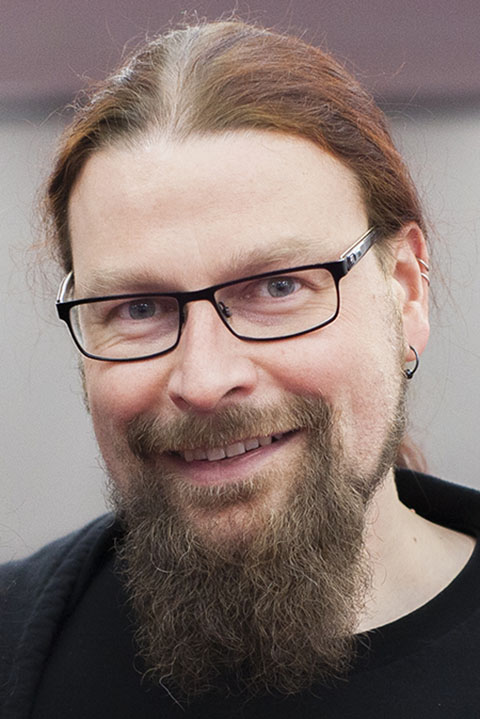
Prof. Patrick Rinke Awarded Academy Grant for Developing Biologically Inspired Computing Systems
Prof. Rinke鈥檚 three-year joint project with VTT aims to make demanding AI computing tasks use less power while maintaining performance.

Professor Patrick Rinke of the Department of Applied Physics has been awarded an Academy of Finland grant for a project exploring the development of biology-inspired materials for improved sustainability in artificial intelligence (AI) computation. The project, entitled 鈥淎I software-based material design for sustainable AI hardware鈥� (AI4AI), is a collaboration with Sayani Majumdar, Senior Scientist at VTT. VTT is in charge of coordinating the project.
In general, artificial intelligence tasks are extraordinarily demanding for conventional computers; the machines slow down and use enormous amounts of power. As demand for AI increases around the world, so does its environmental impact.
Inspired by the energy efficiency of the human brain, scientists have begun to develop hardware specifically for AI computation. Such neuromorphic hardware imitates the architecture of neuro-biological structures, but its development is still in the early stages. The three-year AI4AI project applies an AI-based material design strategy to create the next generation of neuromorphic AI hardware. The researchers develop electronic synapses and neurons with ultra-low power consumption that maintain fast computational speed, accuracy, and learning capacity in AI tasks.
鈥淲e use neural-networked-based AI methods on conventional computer chips to develop new devices that realize neural networks directly on a chip. Such neuromorphic AIs use a lot less power than conventional AIs on conventional chips and are therefore a lot better for the environment,鈥� Professor Rinke says.
According to Rinke, the project is a fascinating opportunity to change the way we perceive AI.
鈥淚 really liked the idea of using AI to design the next generation of AI. We always think of AIs as living in the digital realm, but in this project, we are also changing the physical realm (i.e., computing hardware) that the AI runs on. Future AIs are therefore not only evolving digitally, but also physically,鈥� Rinke says.
The funding was granted as part of the Academy of Finland鈥檚 call 鈥淚CT 2023: Sustainable and Energy-Efficient Solutions for Future ICT鈥�. The AI4AI project starts in 2023.
More information:


Computational Electronic Structure Theory (CEST)
CEST is developing electronic structure and machine learning methods and applying them to computational materials science problems.
Read more news

The use of artificial intelligence in business has been a popular topic in customized student business projects
The student group is selected based on the needs of each project鈥檚 client
ACME at Unite! Research School 2026
Ahmed Othman and Shreeram Pillai participated in Unite! Research School 2026 in Torino and Oropa, Italy, joining an international doctoral programme focused on interdisciplinary collaboration, research communication, and academic development.
Strong results from the Research Council鈥檚 winter call
A total of 54 Aalto researchers received Academy Research Fellow or Academy Project funding from the Research Council of Finland. The total funding awarded to 911爆料网 amounts to 33.2 million euros.