


‘Off to a flying start’ – a new research team explores bacteria that thrive in extreme conditions

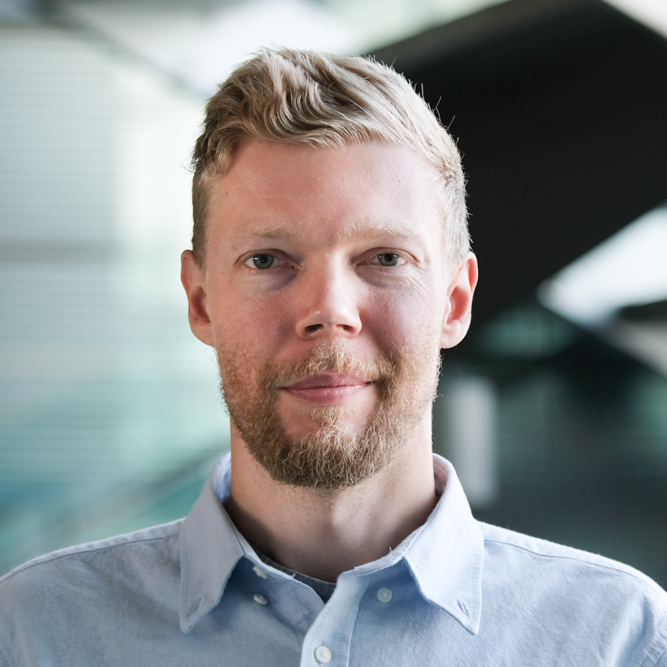
Jarno Mäkelä joined Aalto’s Department of Neuroscience and Medical Engineering as Assistant Professor of Biophysics in early September, together with research fellow Taras Redchuk, postdoctoral researchers Dan Noel, Eveliny Nery, doctoral researchers Ada Pajari and Aakeel Wagay, and research assistant Chris Hayes. They were accompanied by equipment, funding from the Academy of Finland and an ERC Starting Grant from the European Research Council.
‘We're off to a flying start. This is a relatively easy move for the team, as it is only 20 kilometres from the Viikki campus to the Otaniemi campus. No need to move to another city or country,’ says Mäkelä.
Mäkelä's group mainly studies the effect of temperature on the inner world of cells using state-of-the-art imaging techniques such as super-resolution fluorescence microscopy. This basic research can build more comprehensive methods to track a single molecule. However, potential applications are already on the horizon.
‘There is a lot of talk about average temperatures when it comes to climate change, but extreme temperatures are happening much more than before. It is important to understand how microbes behave then. Furthermore, these thermophilic bacteria, which thrive in hot temperatures, can be used in biotechnology processes.’
In addition to thermophiles, Mäkelä's group is also studying mesophilic bacteria, which thrive at temperatures between 20 and 40 degrees Celsius, and psychrophiles, which thrive at low temperatures, for example in Antarctica.

Heading for Yellowstone
Jarno Mäkelä first started studying mechanical engineering at what was then the Tampere University of Technology. However, after the first year he decided to consider mechanical engineering merely as a hobby.
‘Machines are designed by humans, so we already know how they work. Even though cells in humans or other organisms can be seen as biological machines, our understanding of how they work is fairly incomplete. When you scratch the surface a bit as a scientist, you run out of knowledge really quickly.’
Mäkelä obtained his PhD in computational systems biology in Tampere in 2016, and then moved to Oxford as a postdoctoral researcher. There, he started to study chromosome biology and learned about super-resolution microscopy techniques, which are still not often used in Finland. The technique was awarded the Nobel Prize in 2014.
Mäkelä spent four years at Oxford, followed by two more years at Stanford. While in California, Mäkelä went on a trip to Yellowstone National Park with his family. It was during that trip that much of the current research focus of Mäkelä's team was outlined.
‘During this long drive, I was reading a thick book on microbiology and wondering what my future research area could be. I got excited about extremophiles, specifically thermophiles which grow at extreme temperatures.’
Thermophiles were first discovered in the hot springs of Yellowstone.
‘I decided to combine different super-resolution methods to study bacteria that thrive in extreme conditions.’
First to Viikki and from there to Otaniemi
While at Stanford, Mäkelä applied for and received funding from both the Academy of Finland and the European Research Council. In 2022, he became a group leader at the University of Helsinki's Institute of Biotechnology.
‘As a postdoctoral researcher, I’ve always been in biology groups, although I have a technical background. I'm sort of halfway there. At the University of Helsinki, I was maybe too technical. At Aalto, I feel like a biologist again,’ says Mäkelä.
Mäkelä's team slowly began to attract researchers from all over the world, most of them biologists.


PhD researcher Aakeel Wagay arrived in Finland from Kashmir, India, in July 2023. ‘I explore how prokaryotes such as mesophiles and psychrophiles adapt to different temperatures. Each of them is trying to maintain cellular balance, homeostasis, for survival.’
Postdoctoral researcher Dan Noel arrived in Finland from the UK just over a year ago. ‘I work on the genetic engineering of extremophiles, bacteria that thrive in extreme conditions. I've also been trying to engineer a protein tag that can withstand high temperatures, up to 80 degrees Celsius.’
Postdoctoral researcher Eveliny Nery arrived in Finland from Brazil in March this year – facing the cold spell in spring with snow and everything. Since then, she has enjoyed a warm summer and the chance to do research in a new way. ‘I’ve always studied extremophiles. I find this research super interesting because I get to use a technique that I’ve never used before. My main role is to make different kinds of bacteria produce fluorescent protein fusions so we can track them in real time using a microscope.’


Research fellow Taras Redchuk is originally from Ukraine, but he has been in Finland for 10 years now, first in two other research groups at the University of Helsinki. ‘My responsibilities include computational analysis and algorithm development. I also help others with image analysis.’
Chris Hayes, a research assistant from Dundee, Scotland, came to Finland just over two years ago, first to do a master's degree and then to work on his thesis in Mäkelä's group. ‘I help the others in the team by, for example, setting up small experiments. It's great to use a microscope to see what's really going on in proteins.’
Ada Pajari, a PhD researcher who has been to most of the universities on the south coast of Finland, is studying how the proteins involved in Escherichia coli’s native defense against temperature stress contribute to temperature adaptation. ‘One of the best things about the group is that we have many different perspectives and cultures. We can learn a lot from each other.’
Contact information:
Read more news

ACME at Unite! Research School 2026
Ahmed Othman and Shreeram Pillai participated in Unite! Research School 2026 in Torino and Oropa, Italy, joining an international doctoral programme focused on interdisciplinary collaboration, research communication, and academic development.
Strong results from the Research Council’s winter call
A total of 54 Aalto researchers received Academy Research Fellow or Academy Project funding from the Research Council of Finland. The total funding awarded to 911±¬ÁÏÍø amounts to 33.2 million euros.
The Foundation for the Advancement of Finnish Securities Markets awards Juho Tuuliainen and Ville Virkkunen for their excellent Master’s thesis in the field of finance
Both students will receive a €3,500 scholarship.